
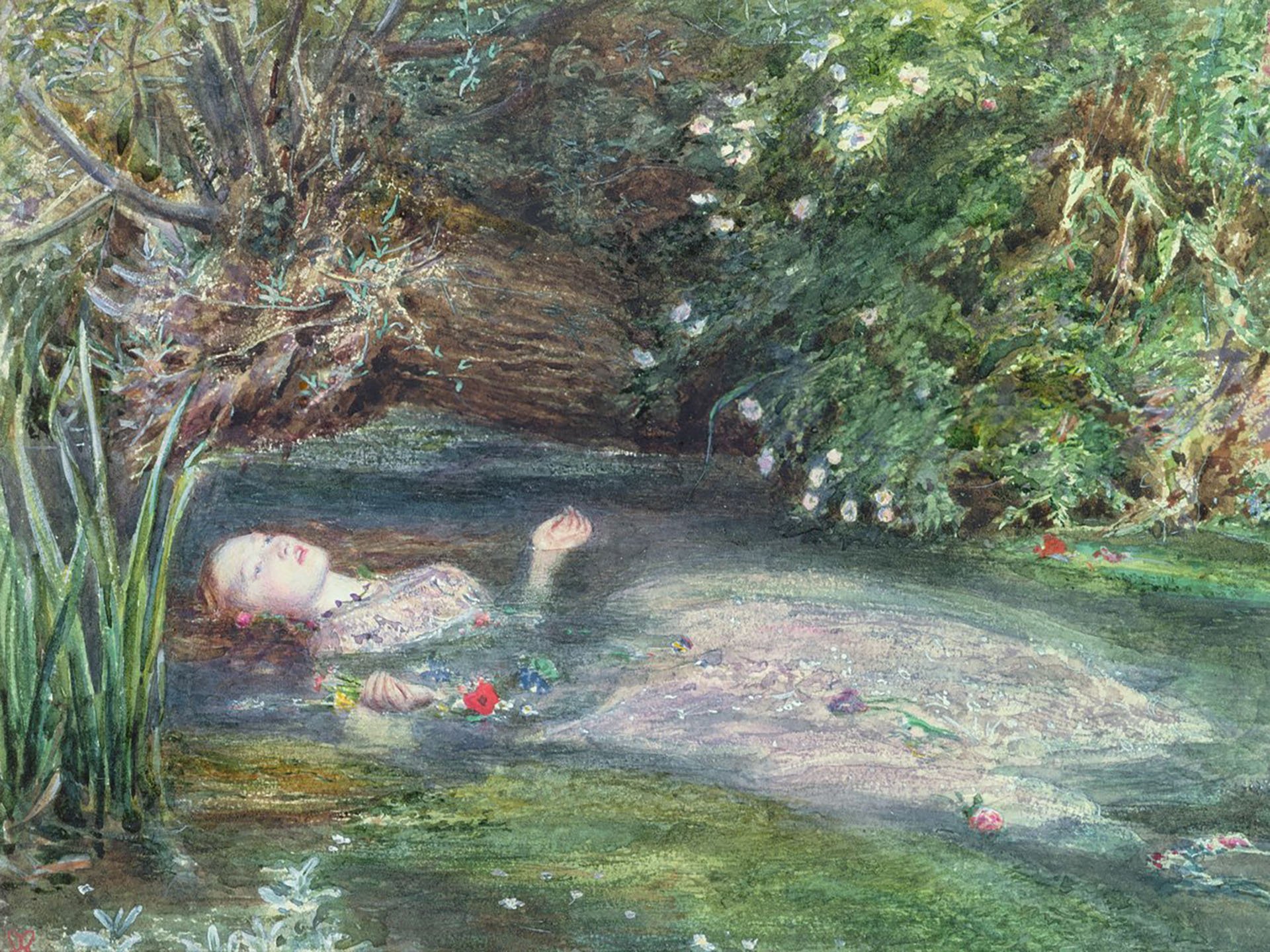
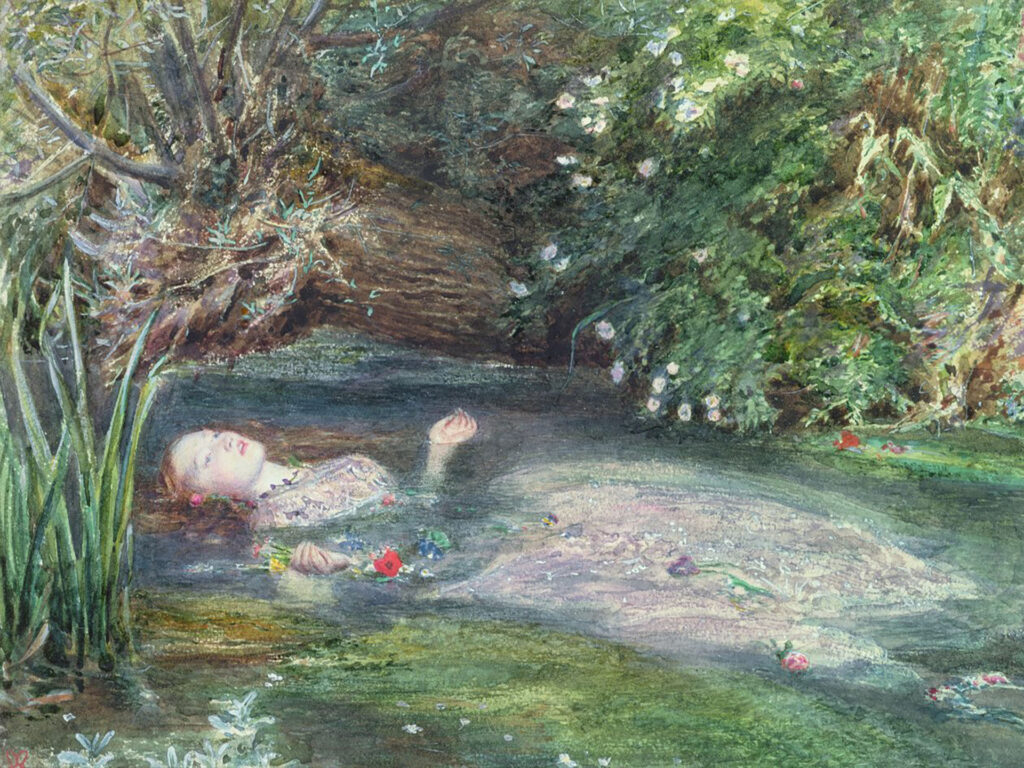
Being one of the most famous works in the canon of British painting, John Everett Millais’ Ophelia (1851–52) has long fascinated audiences, myself included.
I feel sure I am not alone amongst the painting’s legions of admirers in sensing a peculiar, almost mystical quality locked into the canvas by Millais’ deliberate brushstrokes. It is a work that continues to demand attention, not only for its technical brilliance but for its ability to provoke a haunting, almost theatrical encounter with Shakespeare’s tragic heroine.
My own relationship with the painting began during a family visit to Tate Britain (then simply the Tate Gallery) in the early 1980s. As a child, I found myself unable to disentangle the fictional narrative of Ophelia’s drowning from the real-life suffering of Millais’ model, Elizabeth Siddal, who posed for hours in a bathtub of water to help the artist capture the chilling realism of a body submerged in a stream. The anecdote that she developed a severe illness from the sitting lodged itself firmly in my imagination. To my young mind, the story behind the painting was inseparable from the tragic story it depicted, merging the realms of art and life into a single, uncanny impression. That memory has never quite left me, and even today I find that every visit to the gallery demands a moment in front of Millais’ canvas, as though I am compelled to revisit the image that first haunted me.
Beyond its obvious mastery of technique—the luminous rendering of flowers, the shimmering water, the delicate precision of Ophelia’s face—I have always been drawn to the painting’s theatricality.
It is interesting to me that, despite Millais’ strenuous efforts to capture naturalism, the composition still feels staged. The vivid colours and the model’s carefully posed, almost balletic figure create a sense of heightened artifice. Moreover, the disjunction between foreground and background, the fact that the riverbank and the figure were painted separately, is somehow visible. The flowers appear too perfect, the greenery too curated, while Ophelia seems suspended between reality and performance. By conventional standards, this could be seen as a “failure” of integration or, more critically, that somehow the painting is ‘bad’, yet paradoxically it is this very quality that I would argue contributes to the painting’s enduring success.
To elucidate further, the painting oscillates between realism and artifice, nature and theatre. Millais was committed to the Pre-Raphaelite Brotherhood’s manifesto of truth to nature, yet Ophelia demonstrates how that truth was achieved only through painstaking construction. The model posed in a studio; the flowers were studied separately from life; the tragic subject was borrowed from Shakespeare’s Hamlet. It is, in effect, a composite—an elaborate set piece. To a postmodern viewer, it is tempting to read the work not as a window into Shakespeare’s world but as a kind of Victorian film still. Ophelia’s body is spotlighted as though upon a stage, with the natural backdrop functioning almost like painted scenery. One can almost imagine the rest of the cast waiting just beyond the frame, ready to step into their roles once her tragic performance concludes.
The painting thus occupies an ambiguous space between sincerity and spectacle.
It is at once an earnest attempt at naturalism and a deeply theatrical construction, a memorialisation of both Shakespeare’s tragic heroine and the real suffering of Elizabeth Siddal. The emotional charge of the work arises precisely from this layering: the blurred boundary between fiction and reality, stagecraft and authenticity.
For me, that early childhood encounter with Ophelia left behind a residue of both fascination and unease. Each time I revisit the painting, I am reminded not just of Millais’ extraordinary technique but of the way art, theatre, and memory intertwine. Ophelia remains, for me, less a static object than a performance eternally unfolding—a spectacle in which tragedy, beauty, and artifice combine to produce an image that is at once unsettling and sublime.